You just received a traffic ticket in California. The fine is higher than you expected, and now you’re wondering whether you should fight it. Since most courts will give 60 days from the citation date to decide, you can’t afford to wait too long.
Knowing how to fight a traffic ticket in California is useful, but fighting isn’t always the best course of action. If the ticket was issued for a minor infraction, a smarter choice is traffic school, which can mask the point on your record.
For more serious charges, consider going to court or filing a Trial by Written Declaration. Each path has advantages and drawbacks, and the right call depends on your situation.
Not sure where to start? Let’s walk through all three options so you can make an informed decision.
Traffic school can help you keep a clean driving record, prevent insurance increases, and more!
Three ways to handle a traffic ticket (and one you should probably avoid)
Even experienced drivers can be wrongly accused of traffic offenses, from speeding or running a red light to unsafe lane changes. With proper evidence, you may get your ticket dismissed or at least have the charges reduced, resulting in lesser penalties.
In these instances, fighting the ticket makes perfect sense—and you don’t even have to appear in front of a judge. If you’ve been charged with an infraction, you can contest the citation in writing.
However, there are situations where you might be better off going to traffic school. For example, if you were cited for failure to yield to a pedestrian, your chances of winning in court are slim. But if you complete an approved traffic school course, the court will mask the conviction from your driving record, so your insurance company never sees it.
That said, here’s what each path involves and when it makes sense to fight a traffic ticket in California.
1. Contest the ticket in court
One option is to request a court date, show up, and present your case before a judge. Be prepared to gather evidence, build your defense, and go to court at least once.
The trial itself usually lasts 20 to 30 minutes, though it can stretch to two hours depending on the court’s calendar. Getting to trial takes time, too. In California, law enforcement has up to 30 days to submit the ticket to the court, and scheduling a trial date can add another 30 days or more on top of that.
If you win, the ticket is dismissed. If you lose, you pay the fine plus court fees, and the point goes on your record.
A court trial is best suited for drivers with a strong, well-documented case. Think of dashcam footage showing you weren’t speeding, or photos proving a stop sign was hidden by overgrown trees. The more compelling your evidence, the better your chances of getting the charges dismissed.
2. Request a trial by written declaration
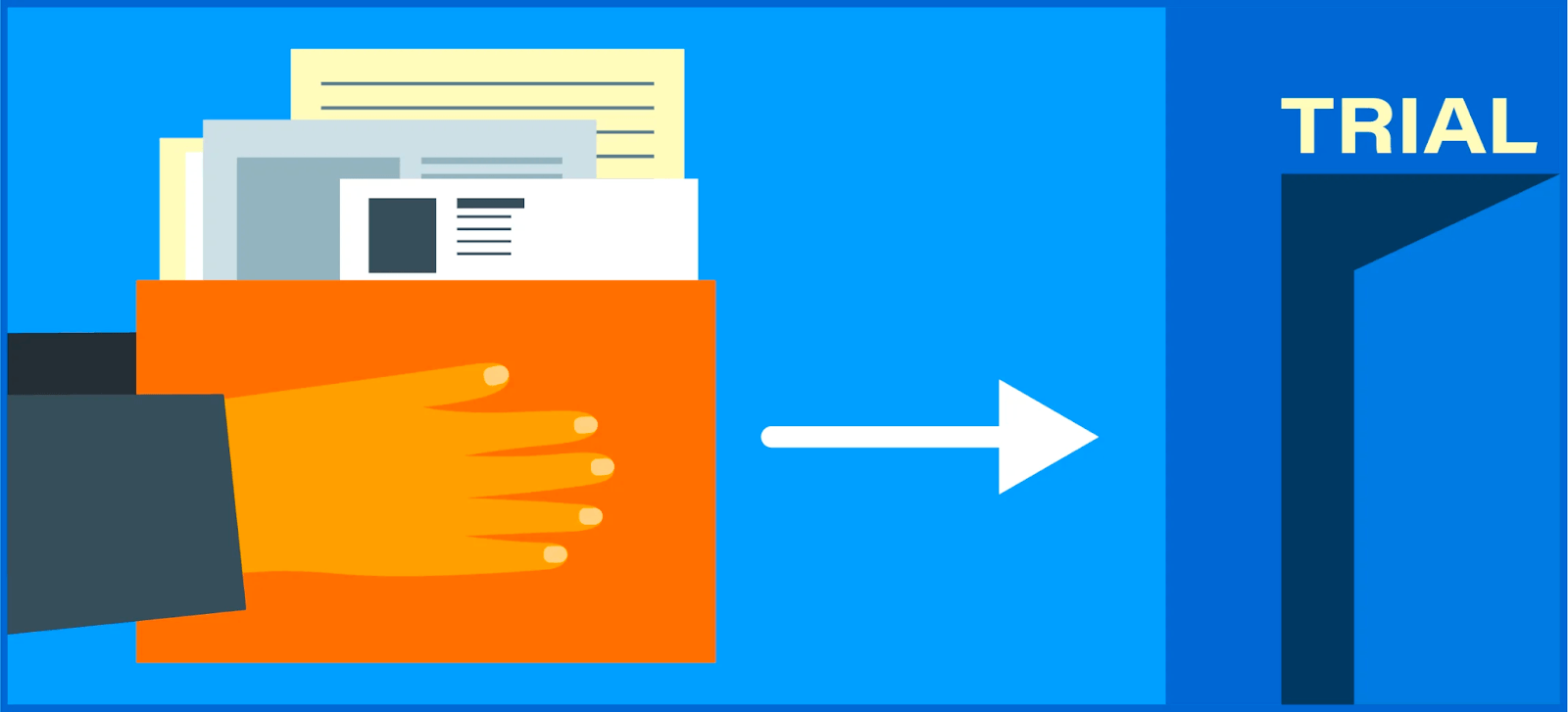
A trial by written declaration (TBWD) is a legal procedure for contesting a traffic ticket in writing rather than appearing in court. You submit a written statement and supporting evidence to the judge, and the officer who issued the ticket must do the same.
The judge reviews both and issues a ruling. If you lose, you can request a Trial de Novo, which gives you a second chance to contest the charges. This is a court trial where the judge starts from scratch without considering the previous evidence or findings.
A TBWD is more convenient than an in-person trial, but it spans several months. Expect 30 to 90 days or longer for your request to be processed, your evidence reviewed, and the ruling delivered by mail. If the verdict is in your favor, a bail refund may take a few additional weeks, since you must deposit the bail amount upfront.
In California, this option is available to drivers cited for traffic infractions (CVC 40902), such as red light camera violations. It’s particularly suitable if your case relies on visual or written evidence like dashcam footage, GPS data, or speed camera images rather than live testimony.
3. Go to traffic school
If you’re eligible, consider taking a state-approved traffic school course online or in person. Upon completion, the point tied to your ticket will be masked from your driving record, making it invisible to auto insurance providers. This way, it won’t affect your insurance premiums.
This option is available to drivers charged with one-point moving violations, like running a stop sign, failure to signal, or texting while behind the wheel. See our guide to California’s Department of Motor Vehicles (DMV) point system to learn more.
Online traffic school allows students to finish in two to three hours at their own pace, while classroom-based courses require eight hours. Either way, you can only attend once every 18 months.
Which option is right for you?
Now that you know more about your legal options, let’s compare them side-by-side to make your decision easier.
| Fight the Ticket in Court | Request a Trial by Written Declaration | Go to Traffic School | |
|---|---|---|---|
| Cost |
|
|
|
| Time | 2–3 months | 1–3 months |
|
| Court appearance | Yes | No | No |
| Points on record | Possible | Possible | No (the point is masked upon course completion) |
| Insurance impact | Possible | Possible | None |
| Risk level | High** | Low to medium*** | None**** |
| Best for | Strong, well-documented cases, including those relying on live testimony | Minor offenses, especially those relying on visual or written evidence | One-point moving violations |
|
* Depending on the complexity of your case ** If you lose the trial, you must pay the fine and court fees — and the point goes on your record. *** The risk is fairly low because of the Trial de Novo safety net. **** The outcome is guaranteed as long as you’re eligible and complete an approved course. |
|||
- Fine + court fees (if you lose)
- $50–$5,000 in attorney fees (optional)*
- Bail amount upfront (refunded if you win)
- $99–$250 for a TBWD service (optional)
- Fine + $49–$79 traffic school administrative fee
- $20–$70 traffic school cost
- ~2–3 hours for online courses
- ~8 hours for classroom instruction
* Depending on the complexity of your case
** If you lose the trial, you must pay the fine and court fees — and the point goes on your record.
*** The risk is fairly low because of the Trial de Novo safety net.
**** The outcome is guaranteed as long as you’re eligible and complete an approved course.
If you’re eligible, a DMV-licensed traffic school like Best Online Traffic School lets you complete the requirement online for $27.99—and your certificate is submitted to the court the same day, free of charge.
What about just paying the fine?
You can also pay the fine and move on. It’s quick, easy, and convenient. The downside is that the point will go on your record, leading to higher insurance rates for 36 months or longer.
According to a 2025 Bankrate analysis, a single speeding ticket can raise insurance premiums by around 39% per year for three consecutive years.
Say you currently pay $3,200 per year for full coverage. If you’re caught speeding and simply pay the fine, your annual rate could jump to $4,448 following the 39% increase. That’s an extra $1,248 per year—or $3,744 over a three-year period.
Paying the fine makes sense only if you’re ineligible for traffic school or have no grounds to contest. Otherwise, it’s worth considering one of the other three options.
How To Fight a Traffic Ticket in California
If you have a strong case, it makes sense to contest your ticket. California law gives you two ways to do it: in person at a court trial, or by mail through a trial by written declaration.
What to expect before, during, and after a court trial
First, check the due date on your ticket. After that, you can appear for arraignment, or the initial court hearing, or visit the clerk’s office to schedule a trial date and post bail. During the arraignment, you’ll hear the charges and enter a plea. The judge will inform you when your trial will take place.
Either way, take action by the due date listed on your citation or courtesy notice. If you miss the deadline, you could be charged with failure to appear and face harsher penalties.
Here’s what to do next:
- Review the ticket for accuracy: If your ticket contains incorrect identifying details, such as the wrong vehicle make, model, or color, it may be grounds for dismissal.
- Research the Vehicle Code(s): The ticket should state the exact vehicle code you’re accused of violating. Look up the full text of the law, and break it down to determine how it applies to your situation.
- Gather evidence: Collect evidence in your favor, like traffic camera footage and witness statements. Find out whether any devices (e.g., radar guns) were used to determine that you violated the law, and research potential defenses against them.
- Build a strong defense: Once you’ve gathered evidence, put everything together and prepare your defense. For instance, you could argue that you broke the law to avoid greater harm, such as swerving to avoid hitting a pedestrian who jumped in front of your car.
- Present your case: Appear in court on time and present your version of the events along with any supporting evidence. Stick to short, factual statements, focusing on what you can prove.
- Await the ruling: If the court finds you not guilty, your bail will be refunded and the ticket dismissed. If the ruling goes against you, the judge will explain the penalties. You also have the option to appeal to the Appellate Division of the Superior Court.
⚠️ Don’t assume your ticket will be dismissed if the officer doesn’t show up. Most courts will just reschedule the trial instead.
How to file a trial by written declaration
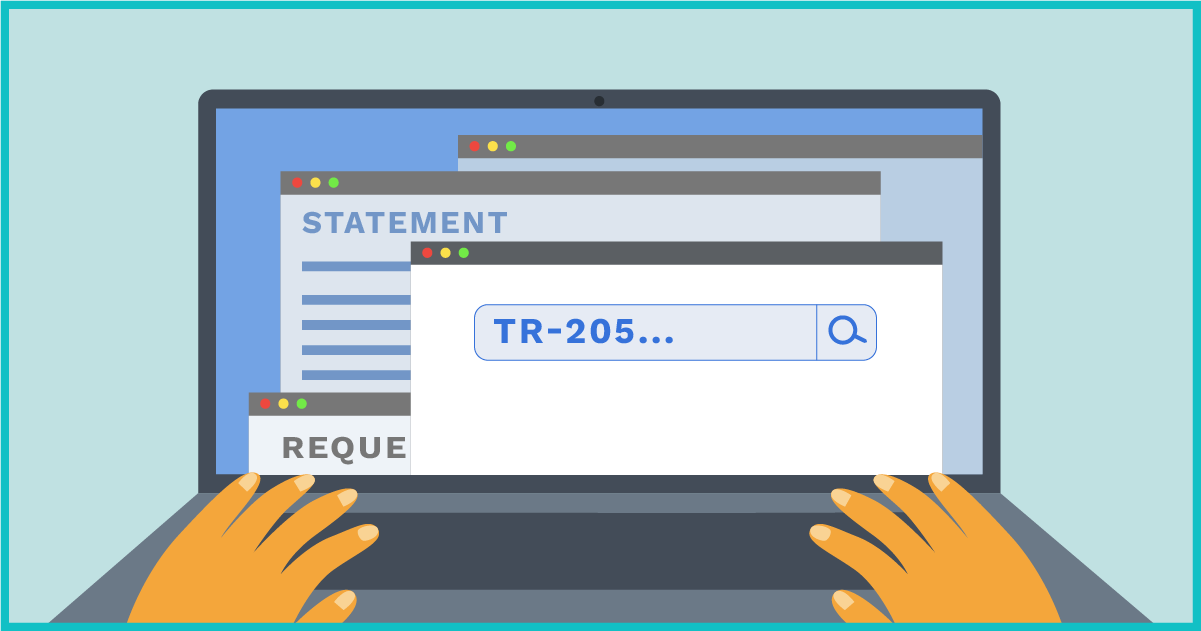
Before you get started, review your courtesy notice to make sure you qualify. If you’re eligible, that option will be listed there. You can also contact the court if you have any questions.
Once you’ve confirmed your eligibility, follow these steps:
- Fill out Form TR-205 to request a TBWD in California.
- Prepare a written statement (which must go under “Declaration of Facts” on the back of Form TR-205) and relevant evidence before the due date on your citation.
- Pay the fine and court fees (full bail) associated with your ticket.
- Submit Form TR-205 along with supporting evidence to the clerk’s office.
- Wait for the court’s decision.
The judge will review your documents and the officer’s statement. Once a decision is made, you’ll receive a notice of ruling by mail.
If the verdict is in your favor, the court will refund your bail and dismiss the ticket. If you’re found guilty, you may need to pay additional fees—or you can request a new trial (Trial de Novo via Form TR-220) to contest the decision.
Which defense strategy should you use?
The right defense for a TBWD depends on the nature of your offense and the evidence available. Some strategies challenge the officer’s judgment, while others focus on procedural errors or the accuracy of the equipment used.
Here are some common approaches:
- Dispute the officer’s opinion: Police officers can have subjective opinions and make mistakes. When that happens, you have the right to defend yourself.
- For example, if you’re cited for an “unsafe” movement, you may be able to argue that the officer made an incorrect judgment and your actions were, in fact, safe. Support your argument with dashcam footage, witness statements, or photos of the road conditions at the time of the incident.
- Challenge the evidence against you: Question the accuracy of radar or laser equipment, or whether it was properly calibrated. You can also challenge other forms of evidence as long as you have proof to back it up.
- For instance, if you were cited for making an illegal turn, submit photos proving the signs were missing, faded, or obstructed by a building.
- Claim necessity: Sometimes, drivers are forced to break the law to prevent a more serious incident. In these cases, you’ll need evidence to prove your actions were necessary to avoid greater harm, such as swerving to avoid a collision.
- Argue a mistake of fact: If you genuinely believed you were following the law, you may have a valid defense. Maybe you turned onto a closed road because the signage was unclear or missing. The judge may be willing to dismiss or reduce the charges as long as your misunderstanding was honest and reasonable.
- Prove your actions were legally justified: If the circumstances reasonably justified what you did, a judge may rule in your favor. For example, if you were driving well below the speed limit in the left lane, you could argue that you had to slow down to make a lawful left turn. You’re not denying the behavior, but providing the context that makes it legal.
Note that some TBWD services claim dismissal rates of 50% or higher, but there’s no independent data to back that up. As with a court trial, the outcome depends on your defense strategy and how the judge interprets it.
Traffic school as a strategic choice
For many drivers charged with minor offenses, traffic school is the simplest path to the outcome they actually want, which is no point on their record and no insurance increase. It’s faster, less stressful, and easier on the pocket than fighting your ticket.
How traffic school works in California
When you complete traffic school, the court masks the conviction on your driving record. The violation still exists on your court record, but insurance providers and other third parties can’t see it. Since the point is “hidden,” it won’t affect your DMV record or raise your insurance premiums.
To get started, plead guilty to the charge and pay the fine plus a traffic school administrative fee. Then, register with a state-approved school and take the course. Upon completion, the school submits your certificate to the court and DMV.
Beware that if the course provider isn’t DMV-licensed, your certificate won’t be recognized. Best Online Traffic School’s California course is DMV-approved (License no. #E1314), takes around two to four hours, and includes free same-day certificate filing. Plus, you don’t pay until you pass.
Are you eligible for traffic school?
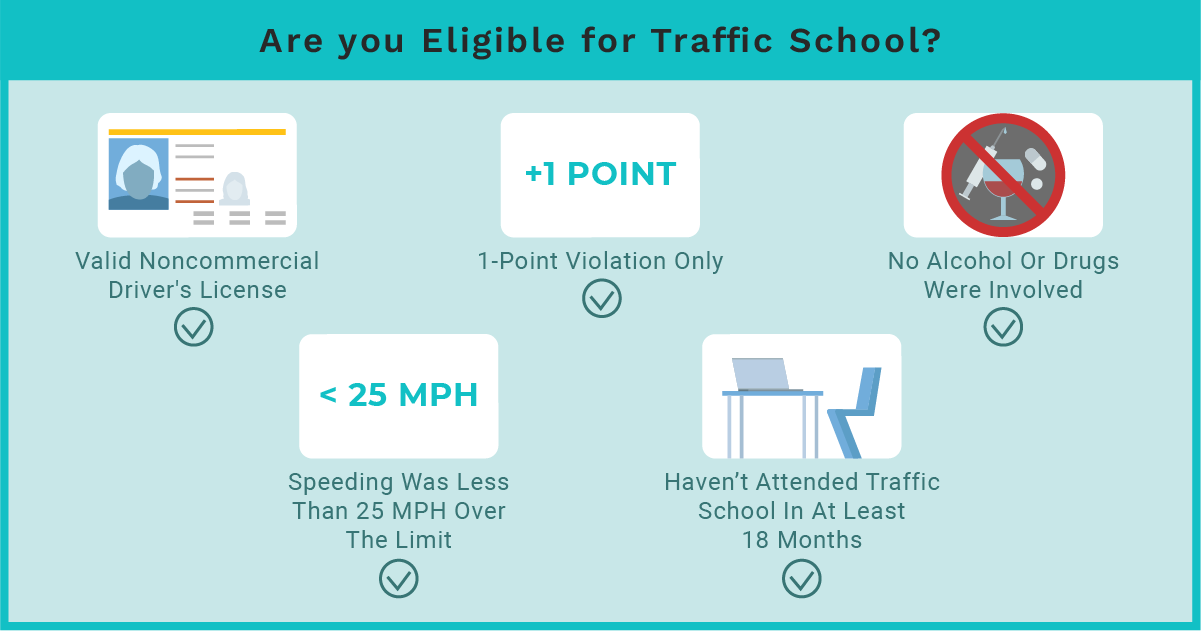
Not all drivers are eligible for traffic school. To qualify, you must meet the following requirements:
- Hold a valid noncommercial driver’s license
- Be charged with a one-point moving violation
- Not have been driving under the influence of alcohol or drugs
- Not have exceeded the posted limit by more than 25 mph
- Not have attended traffic school in the last 18 months
For example, exceeding the 65 mph speed limit on a California freeway is a one-point offense under the Negligent Operator Treatment System (NOTS). Therefore, it qualifies for traffic school as long as all other requirements are met and your speed was no more than 25 mph over the limit.
By contrast, driving over 100 mph on a highway falls under CVC 22348(b), which carries two points and is not eligible for traffic school.
Traffic school vs. fighting your ticket: Cost breakdown
Traffic school costs significantly less than fighting your ticket, with or without legal help.
Say you register with Best Online Traffic School. You pay a flat fee of $27.99 to complete the course, and certificate submission to the court and DMV is free.
Compare that to filing a TBWD through a specialized service, which runs between $99 and $250 depending on who you hire. Fighting in court costs even more, as legal representation for minor traffic cases typically starts at $200.
And unlike traffic school, neither option guarantees a point-free outcome.
Why is your traffic ticket so expensive?
One reason so many drivers choose to fight their ticket is the final amount. A $70 base fine for going 20 mph over the posted speed limit in Marin County, for instance, ends up being over $360 once administrative and court fees are added.
Here’s how it breaks down:
Base fine: $70
State penalty assessment: $70
County penalty assessment: $49
Court penalty assessment: $35
DNA penalty assessment: $35
EMS penalty assessment: $14
Surcharge: $14
Court operations assessment: $40
Conviction assessment: $35
Night court: $1
______________
Total bail: $363
These additional fees come from California’s Uniform Bail and Penalty Schedule, a statewide policy that standardizes the amounts owed for specific offenses. The goal is to ensure that bail and penalty amounts are set according to consistent, uniform guidelines rather than varying by county or court.
Because of this policy, even a minor traffic violation can cost you a few hundred bucks. And that’s before factoring in the insurance rate increase if the ticket goes on your record.
What happens after you get a ticket: timeline and deadlines

After you receive a traffic ticket, you have less than three months to decide your next step: Fight it in court, pay the fine, submit a TBWD, or attend traffic school. Wait too long, and you risk additional penalties and higher fines.
This is how things unfold:
- Courtesy notice: Expect to receive a court notice by mail within 30 days or longer after you get a citation. This document lists the charges, the total fine, the response deadline, and your legal options. If you’re eligible for traffic school, it should appear on your courtesy notice.
- Response deadline: Depending on the court, you have 60 to 90 days to enter your plea and take action. If you miss that window, you may face a late fee of up to $100. The court can also charge you with failure to appear and add the violation to your driving record.
The due date will also appear at the bottom of your traffic ticket, so you don’t have to wait for the courtesy notice to respond. The court notice simply repeats the same information, serving as a reminder.
Courts may show some flexibility if you have a valid reason for missing the deadline, such as an illness. Just make sure you inform the court before the due date to request an extension.
Depending on how you decide to handle your ticket, take note of these timelines and deadlines:
| Course of Action | When To Act | What To Do | Verdict Wait Time |
|---|---|---|---|
| Trial by Written Declaration | Within 60–90 days of the citation date | Submit your written statement and bail payment before the due date. | 30–90 days or longer |
| In-Person Trial | Request within the same 60- to 90-day window, or within 20 days of receiving the TBWD verdict (if the ruling isn’t in your favor) | Appear in court on the scheduled date to present your case. | None. Instant ruling (except for complex cases). |
| Traffic School | Request court approval within 60–90 days of the citation date. | Enroll in a DMV-licensed course and complete it within 60–90 days. | N/A. The point is masked as soon as the court processes your traffic school completion (1–3 weeks). |
Remember that traffic school can take as little as two or three hours if you complete it online. That means you can start and finish the course even on your due date. At Best Online Traffic School, your completion is electronically submitted to the court and DMV the same day you pass.
Why choose Best Online Traffic School
Fighting your citation can lead to ticket dismissal, but you need to decide if the risk is worth taking. Consider the circumstances of your offense, as well as the strength of the evidence you can bring.
A more straightforward option is traffic school. While it can’t dismiss your ticket, it masks the violation from auto insurers. You still pay the fine, but you walk away with no point on your record, no insurance increase, and no courtroom stress.
Best Online Traffic School makes the process as simple as possible. Our course is approved by the California DMV and accepted by all state courts, allowing drivers to learn at their own pace.
Once enrolled, you can study from any device and finish in one sitting or over several sessions.
Need a break mid-lesson? No problem. Come back when you’re ready, and pick up right where you stopped.
Here’s what you’ll get:
✅ 12 lessons with easy-to-follow materials
✅ Practice quizzes after each module
✅ Unlimited course retakes
✅ Automatic progress tracking
✅ Free audio read-along in English, Spanish, and Chinese
✅ Same-day certificate submission to the DMV and court
✅ Free digital certificate for your records
✅ 24/7 live chat support in 100+ languages
✅ 28,137 positive reviews | 4.92 rating | 99% pass rate
All of this is covered by our flat fee of only $27.99. And you don’t even have to pay until you pass.
We’re aware that nobody signs up for traffic school on a good day. You’re here because you have to be. So we built a course that doesn’t waste your time: clear lessons, no filler, and real humans behind every word of it.
Ready to give it a try? Check out the 28,137+ reviews from California drivers who took our course. To date, we’re the highest-rated traffic school in the state.
Don’t let a traffic ticket bump up your insurance rates. Start traffic school for FREE today.
FAQs about How to Fight a Traffic Ticket in California
What else would you like to know about fighting a traffic ticket in California? Below are the answers to some of the most common questions we receive from our students.
What happens if I can’t afford to pay the fine?
Most California courts offer options for drivers who can’t afford to pay their traffic fines in full. Depending on your situation, you may qualify for a payment plan, a fine reduction, an extension, or community service in lieu of paying.
Contact the court before your due date. You can go in person, send an email, or submit a request online via MyCitations.
Can an out-of-state driver attend California traffic school?
Generally, no. You must hold a valid California driver’s license to be eligible for traffic school in this state. If your ticket was issued under an out‑of‑state license, the court clerk cannot approve traffic school.
However, if you have a valid California license in addition to an out‑of‑state one, you may still qualify, but only after a judge amends the citation.
In such cases, you’ll need to appear before a judge and request that the citation be amended to reflect your California license. Remember to do this before the due date on your ticket.
How many points does it take to lose my driver’s license in California?
Under California’s Negligent Operator Treatment System (NOTS), the DMV will suspend your license for six months if you accrue:
• 4 points within one year
• 6 points within two years
• 8 points within three years
You’ll receive a warning letter before you reach the suspension threshold, followed by a Notice of Intent to Suspend as you get closer. If you don’t take action (e.g., request a NOTS hearing or complete traffic school), you’ll lose your driving privileges.
How long do traffic tickets stay on your record in California?
Traffic tickets stay on your record for three to 10 years, depending on the nature and severity of the offense. Generally, one-point moving violations stay on your record for three years.
Can I fight a fix-it ticket in court?
Fix-it tickets are correctable violations, and there’s no need to fight them in court. Take care of the issue, get it signed off by a police officer or other authorized person, then pay a $25 administrative fee to have the charge dismissed.
Got pulled over for a broken taillight? Fix it, show proof, and you’re done.